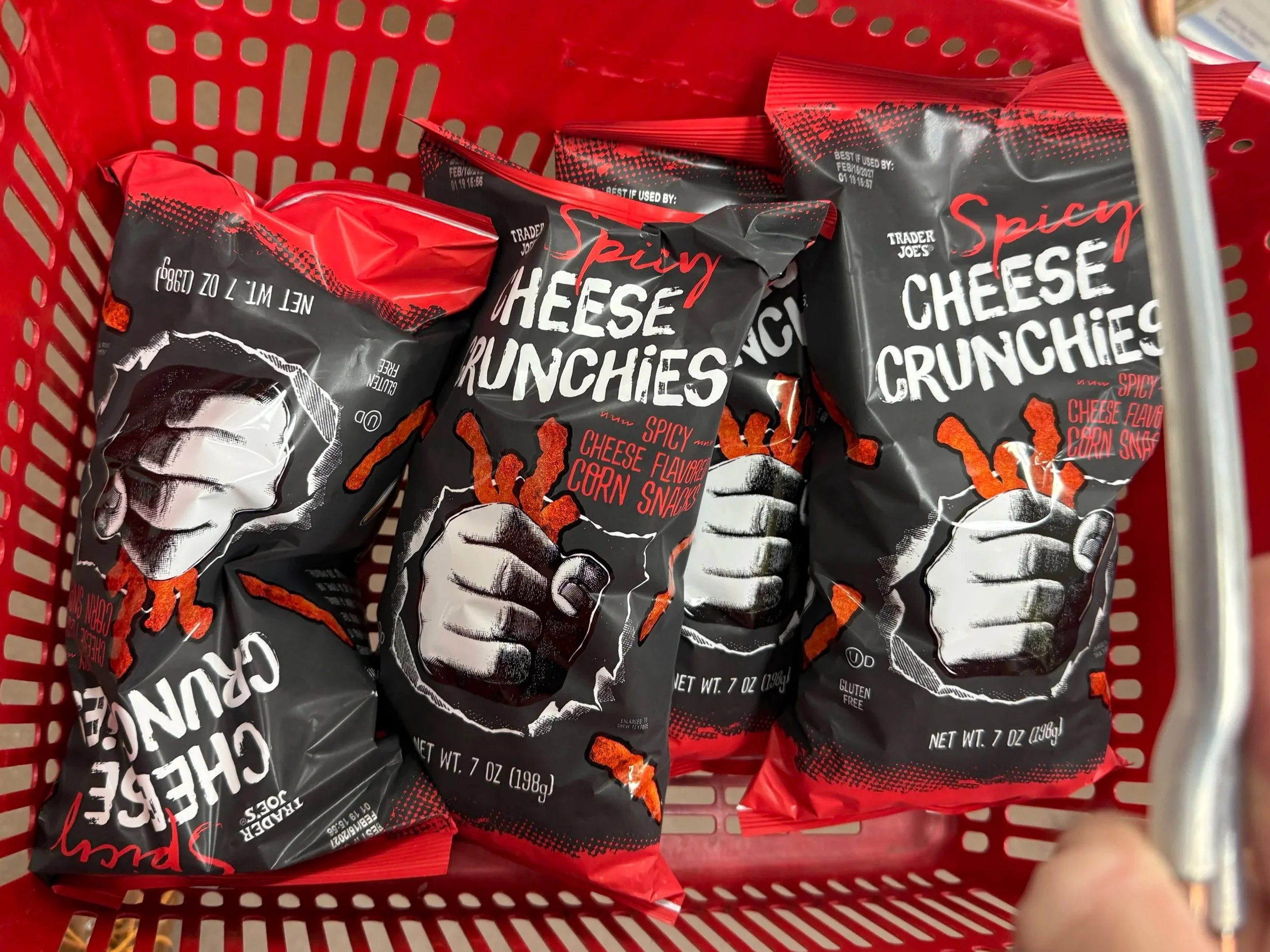
Spicy Cheese Crunchies from Trader Joe’s are pretty damn good.
I don't like exercise. It isn't exciting, I don't enjoy it, or look forward to it. I do like how it makes me feel: less anxious, more focused. I like what it gives me.
I spoke with a personal trainer and strength coach, Steve Crandall, about exercise and ADHD. Exercise and strength training are important for different reasons now. I'm older, and what I took for granted is what I have to work for now. If I want to stay healthy and be on the planet longer, healthy habits are the key.
Exercise and ADHD don't always go hand in hand. While the benefits of exercise for better mental health outcomes are well documented, that doesn't always get me off the couch. I have to create a spark of interest or arousal to get started. It has as much to do with interest in a task as it does with attention (Wiersema & Godefroid, 2018). Finding motivation for a 30-minute workout doesn't produce that spark, yet.
A brain like mine works better with a 30-minute workout broken down across the day: ten 3-minute bites. Three minutes is about how long I wait on the microwave. I could exercise in that time. Research on "exercise snacks" found they improved cardiorespiratory fitness in physically inactive adults (Rodríguez et al., 2026). In theory, it gives me the same dopamine hit and feeling of accomplishment as eating when I'm bored. The difference is that exercise dopamine doesn't have a crash later.
Novelty of a new idea or "spark" disappears quickly. After talking with Steve, I was excited. This was a whole new me showing up to get fit and stay that way. I was going to spread the good news and write about it too. Then I got home. I checked email, took a phone call, and fiddled around my desk. When the idea to write came around again, the desire was gone. I told myself, "You said you wanted to do this, so just do it."
Sometimes doing something grumpy is the only way to get moving. Not waiting for motivation to begin a task feels like driving your car in winter right after turning the ignition. It will move, but it takes a while to warm up.
Consistency is more important than intensity. Daily movement and functional strength training as part of a busy day is something I can manage better than scheduling a daily 30- to 60-minute workout.
One way to change a habit, with or without ADHD, is breaking it into small, specific parts (Peng et al., 2022). Intensity of exercises rises on its own once frequency is solid. It's called "getting in shape." That's easier when my mind starts saying "it's 3 minutes." It might be an intense 3 minutes, but it won't put me on the couch.
Thinking about exercise the way I think about snacking is a good shift. I'm creating a new habit on the foundation of two I already have. I snack. I eat late. I don't think about either one while I'm doing them. Changing habits a little at a time lets me shift without feeling like I'm giving anything up. It feels good too.
There is no magic bullet and no single way to exercise. Everyone has a routine that works for them. Mine may or may not work for you.
Tai Chi has taught me to move efficiently, which prevents injury. It also is something I can do any time of the day.
I have made peace with the fact that I probably won't be a gym rat anytime soon, but I want to be physically healthy and clear-headed. In my mind, I have either been the master of something or the total beginner. Developing new habits around exercise bridges the gap between starting and staying at something, 3 minutes at a time.
References
Peng, S., Othman, A. T., Yuan, F., & Liang, J. (2022). The effectiveness of planning interventions for improving physical activity in the general population: A systematic review and meta-analysis of randomized controlled trials. International Journal of Environmental Research and Public Health, 19(12). https://doi.org/10.3390/ijerph19127337
Rodríguez, M. Á., Quintana-Cepedal, M., Cheval, B., Thøgersen-Ntoumani, C., Crespo, I., & Olmedillas, H. (2026). Effect of exercise snacks on fitness and cardiometabolic health in physically inactive individuals: Systematic review and meta-analysis. British Journal of Sports Medicine, 60(2), 133–141. https://doi.org/10.1136/bjsports-2025-110027
Wiersema, J. R., & Godefroid, E. (2018). Interoceptive awareness in attention deficit hyperactivity disorder. PLOS ONE, 13(10), Article e0205221. https://doi.org/10.1371/journal.pone.0205221