The Algebra of Success
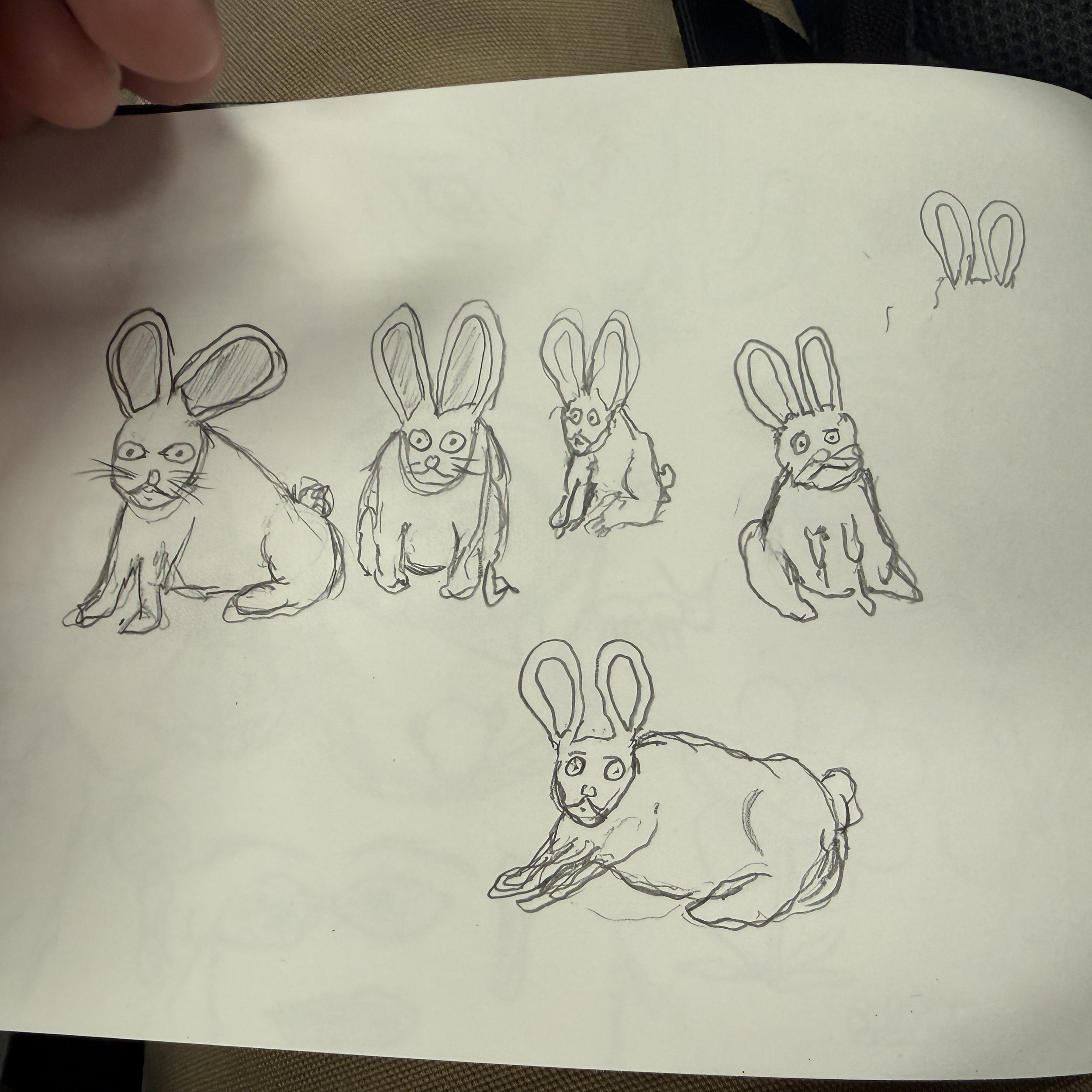
Drawings of Bunnies
I stopped drawing because I didn’t think I was good enough to continue.
I always loved to draw, but somewhere along the way I made a deal with myself: I would only do things I could do well from the start. Drawing didn’t qualify, so I stopped. It wasn’t until my Expressive Arts class in grad school, where mark making and doodling were framed as part of a healing process, that I returned to drawing with a childlike joy.
The fun was never in the quality of the work, but in the making of it. Quality rises slightly with the quantity, and pictures started to look like what I was trying to make. This didn’t happen because I got talented, but because I stopped skipping steps.
There’s a question people use as an icebreaker sometimes: if you knew you couldn’t fail, what would you do? It’s meant to be inspiring, but it’s asking the wrong thing or, at least, asking it the wrong way. Failure is not the single catastrophic event we imagine it to be.
Dr. Russell Barkley, one of the leading researchers on ADHD, puts it plainly in Taking Charge of Adult ADHD: “ADHD is a disorder of performance: of doing what you know rather than knowing what to do.” People with ADHD often know what’s expected of them, usually better than anyone else in the room, because they have had considerably more reminders about it. The problem isn’t ignorance, but the gap between knowing and doing. That gap is neurological, not moral.
Here is the specific cruelty of it for me. Knowing the steps does not help. It makes things worse. When I can see the whole staircase, I stop at the bottom and calculate how long it will take to climb. I weigh whether I am up for it. I negotiate with myself. I decide I will start tomorrow when I have more energy, more time, more of whatever quality I believe I currently lack. This is not laziness, and it is not poor time management. It is a freeze response that occurs when a task is so large or emotionally loaded that the brain cannot locate a starting point. The task feels like a verdict instead of something manageable.
Motivation, a better attitude, and firmer commitment are not the solution. Breaking the task into smaller steps stops the brain from arguing with itself.
Task paralysis is the term for when the brain locks up at the start of something, because the whole project lands at once, and the brain can’t find a starting point. From the outside it can look like laziness. From the inside, it feels like standing in front of a wall. A large, undefined task has no entry point the brain can grab. A small, specific one does. Research into ADHD and executive function consistently shows that this is a neurological freeze response, not a character flaw.
I genuinely struggled with algebra, which makes what I’m about to say either ironic or fitting. Algebra is not magic. It is arithmetic, applied. It teaches people to take larger, complex ideas and reduce them to smaller, solvable parts. Learning algebra is learning the order of operations. Every student who ever asked a teacher “when will I ever use this?” uses it several times a day. They just stopped calling it algebra.
The idea of “you can’t fail” works when it is grounded in succeeding at the smaller parts of a greater whole. Hard parts are individually winnable. You can succeed at a single training run. You can succeed at one bad drawing session. You can succeed at writing a paragraph or a page.
What does this look like on an ordinary Tuesday? The task isn’t “clean the kitchen.” The task is picking up a dish and bringing it to the sink. The task isn’t “write the essay.” It’s opening the document and typing the title. Not the first paragraph. The title. Each of those is a complete task, and finishing something, even something small, gives the brain what it needs to consider the next thing.
I avoided writing for this site for three weeks once. I had the topic, but not the ability to sit down and begin. When I opened the document, the entire finished essay, with the structure, argument, and conclusion, rose to meet me. The whole thing was already neatly finished in my head and couldn’t withstand the messiness of starting.
Now I have a system that lowers the stakes. I dictate, proofread, and revise. Filling the page with a transcription is easier than typing.
This is not a productivity system. There are no “hacks.” Most of those are built for brains that don’t work like mine. This is more of a reframe than a method. The goal isn’t to become more efficient. The goal is to stop treating the size of a task as evidence of my own inadequacy. Big projects become manageable when broken into smaller steps. It is easier to act on smaller parts than to attempt the whole thing at once.
Another thing I struggle with: knowledge of the steps somehow convinces me I can skip them. I cannot. Nobody can. Knowing how to do something and doing it are not the same thing. I am guilty of being a hero in my own mind.
Drawing teaches me this. The work improves over time as a pleasant by-product of enjoyment. I’m not working harder, but enjoying the process more.
What does it mean to not fail?
The icebreaker question assumes failure is binary. You either succeed at the whole thing or you do not. That framing is not useful for anyone, but it is particularly punishing for a brain that already struggles to see the distance between where it is and where it is trying to go. Task initiation in ADHD depends on immediate, concrete reward, not on the importance of the larger goal. Redefining success at the level of the single step is not lowering the bar. It is putting the bar somewhere you can reach it.
I did not fail at drawing for all those years. I failed at one thing: not giving myself permission to be bad at it. Once I did that, the rest followed. Not quickly or dramatically, but steadily. One bad picture at a time.
The question is not whether you can do the whole thing. The question is whether you can do the next smallest part of it. Most of the time, the answer is yes.
You get to keep everything you make. That has always been true. It just helps to start.